
I Stopped Saying "I'll Let You Know"
I Stopped Saying “I’ll Let You Know”

I have had migraines for six years. In those six years I have cancelled more dinners, birthdays, weekends and visits than I can count. Not because I wanted to. Because by the time Friday came, I was either in the middle of an attack, recovering from one, or so afraid of triggering one that leaving the house felt like a gamble I could not afford to lose.
The people in my life learned not to count on me. They didn’t say it like that. They said “no worries” and “feel better” and “we’ll figure something out.” But what I heard, every time, was: you are the person who cancels.
My daughter stopped inviting friends over on days I looked tired. My husband started making backup plans for every plan we made. My closest friend from college texted me after I cancelled our third lunch in a row and said, “Just tell me when you’re having a good day and I’ll come to you.” She meant it kindly. It broke my heart.

I want to tell you what changed, because if you are reading this on a phone in a dark room with your thumb hovering over a text that says “I don’t think I can make it,” then you already know every word of what I just wrote, and what I’m about to explain might matter to you.

There is a nerve running through your head called the trigeminal. It is the nerve that carries your migraine pain — the pressure behind your eye, the tightness across your forehead, the sensitivity to light, sound, and smell. Two branches of it come up to the surface right above each eyebrow, just a few millimeters under the skin.
Every pill you take for a migraine — your triptan, your Excedrin, whatever you reach for — has to travel through your stomach, your liver, and your bloodstream before it reaches that nerve. That trip takes about thirty to forty minutes. By then, the migraine has already settled in, and your evening is already cancelled.
There is a device that sits directly on the two spots where that nerve surfaces.

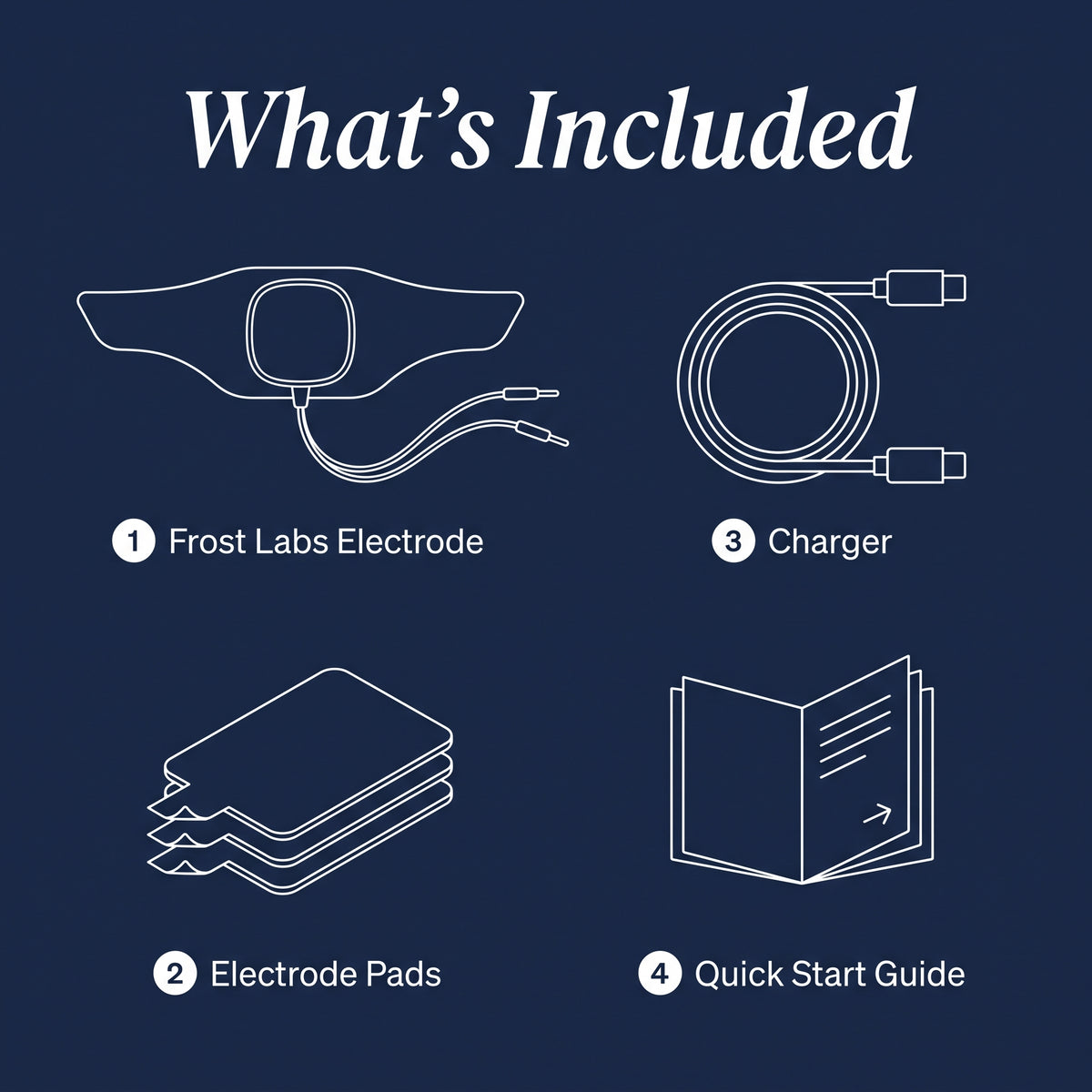
It is called Frost Labs One. A thin pad goes across your forehead with a gel zone above each eyebrow. A small pod snaps on with a magnet. You press one button. For forty minutes, it sends gentle electrical pulses straight into the nerve — no pills, nothing enters your body, no thirty-minute wait for something to dissolve in your stomach and find its way up.
The pulses occupy the nerve pathway. Your nervous system can only carry so many signals at once from one area, and while the device is running, the pain signal loses its space. You feel a steady tingle that fades into the background after about a minute, and the migraine fades with it.
Here is what changed the “I’ll let you know” for me.

The device has a second program — twenty minutes, once a day, for prevention. I run it most evenings on the couch after dinner. Over four to eight weeks of daily use, it trains the trigeminal nerve to be less reactive. The nerve fires less easily. Smaller triggers stop setting it off. You don’t just treat the attacks you have — you start having fewer of them.
That is the part nobody told me about. I bought the device for the attacks. I kept using it because the attacks started coming less often. Fifteen days a month became nine. Then seven. I stopped tracking because I stopped needing to.
What it is, plainly:

- One button. Completely silent. Works in the dark.
- 40-minute session for an active migraine. 20-minute daily session for prevention.
- Nine intensity levels, all set by you. It starts at 1 every time and never turns itself up.
- The session ends itself. Falling asleep wearing it is fine.
- No prescription. No monthly limit. No subscription.
- The pads are reusable for weeks. When they wear out, replacements cost a few dollars.
90 days to try it. If it does not change how you experience your migraines, send it back for a full refund. That is three full months, which is enough time to run the daily program through a real cycle and see whether your numbers change the way mine did.
Batch 3 is the last pre-order. The first two sold out. Free shipping. Two-year warranty on all pre-orders. Ships mid-December.
I texted my friend last week. Not to cancel. To suggest a place.
She wrote back:
I am. I can do that now.


Original Frost Labs One™
Original Frost Labs One™
✓ Fast Migraine Relief: Instantly calms the trigeminal nerve
✓ Fewer Migraines Over Time: Calms trigeminal nerve activity to help reduce migraine frequency.
✓ 90-Day Guarantee: Try it risk-free for 90 days.
Original Frost Labs One™

How To Use?
How To Use?
How to Use
- Prep your skin. Make sure your forehead is clean and dry — no lotion, no makeup, no oils. This helps the pad stick and the signal flow.
- Place the pad. Press the gel pad across your forehead, with the two gel zones sitting just above each eyebrow. Smooth the edges down firmly.
- Snap on the pod. It clicks into the center magnetically — you'll feel it seat.
- Press start. One press powers it on. Choose RELIEF (40 min) when pain is present, or DAILY (20 min) for your everyday session — on the device or in the app.
- Find your level. Step the intensity up until you feel a strong but comfortable tingle. It should never sting or feel sharp — if it does, press the pad edges down and drop one level. You can adjust anytime mid-session from the app.
- Let it run. Lie back, close your eyes, lights off if you like. The session ends itself — even if you fall asleep.
- After. Peel the pad off slowly from one edge, stick the liner back on, and store it in the case. With clean skin and the liner replaced, one pad lasts weeks.
Why should I pre-order?
Why should I pre-order?
You pay $139.98 instead of $219.98 — $80 off, and the lowest this device will be.
Batch 3 is the final pre-order batch. Order after it closes and you're waiting months for the next run.
No refill card, no subscription, no software-locked sessions. Standard reusable pads, bought anywhere. You buy it once and it's yours.
PLUS: pre-orders get a 2-year warranty instead of our standard 1 year.
When will I get it?
When will I get it?
Batch 3 is in production now and ships in mid-December 2026. You're reserving a unit from that run.
It's also the last batch we're opening to pre-order. Orders stay open afterwards, but those units come from the following production run — several months behind this one.
What if it doesn't work for me?
What if it doesn't work for me?
Every order is backed by a 90-Day Risk-Free Trial. Use it through a real attack, use it nightly for a few weeks, and if you don't feel a difference, send it back for a full refund.
Start at level one and step up. The most common mistake with these devices is going too strong on the first session — the level that works is strong but never uncomfortable.


Three Steps. Forty Minutes.
On in about thirty seconds, silent, and usable lying down in a dark room. You set the intensity across nine levels — nothing climbs unless you climb it.


Every pulse is biphasic and charge-balanced — 250 µs, 60–100 Hz, 16 mA maximum. Printed here because you should be able to check them.
What 12,000+ People Felt
*Based on customer survey. Individual results vary. Judge DAILY after 4 to 8 weeks, and count migraine days, not pain scores.
In Their Words, With the Hedges Left In
"Set a reminder to return it on day 80. Cancelled the reminder. My worst ones still win, but the mid-level ones that used to eat a whole afternoon mostly stall out now. Hedging because I've been wrong before."
"Bought it because my wife was tired of me pricing a Cefaly every few months. Same spot on the forehead, a third of the money. Two attacks so far, both shorter. Too early for more than four stars."
"Days 26 to 2 are still my bad window, but this cycle I ran DAILY every night the week before and lost one evening instead of three. Could be luck. Trying it again next month."
"Coming off years of Excedrin and needed something that wasn't a pill. This is what I reach for at the 'is this one real' stage now. Used four triptans in August. Was nine."
"Aura hits, I have maybe 25 minutes. Pad lives in the nightstand, pod on the charger next to it. Running before the pain lands, most times. The LED is bright enough to find with the lights off."
"Mine come with the room spinning, so flat on my back is non-negotiable. It holds on when I'm horizontal and doesn't make a sound. My partner sleeps through the whole thing."
"Month one I nearly quit. Month two: 14 days down to 8. Still on Emgality, still see my neuro, she just wrote 'continue' this time. Eight is a number I can plan around."
"Mine start at the base of the skull, so I was doubtful. RELIEF once it's fully going does less than I hoped. DAILY over six weeks, fewer bangers. Pad lost its stick faster than I'd like on my skin."
"Batch 2 buyer. The ship date they gave was the date it arrived. Asked support whether the 90 days start at charge or delivery. Delivery, in writing, from someone with a name."


Eight Things People Ask Us Right Before They Order
"If it were this simple, my neurologist would have told me."
She may have — as the $500 version, which is why it stayed on the list and never made it into your bag. Trigeminal stimulation is a standard line in neurology; the barrier was always price and access, never the site. Ask her about Frost Labs One by its parameters: 250 µs, 60–100 Hz, 16 mA maximum, nine levels, forehead placement. That is the conversation worth having.
"Mine start in my neck. A forehead device feels like the wrong end."
Yours are not unusual, and the forehead is still the right site. The sensory nerves of the upper neck and the trigeminal branches feed into the same relay in the brainstem, which is why the forehead is the established stimulation site regardless of where an attack begins. The device is forehead-only and is not for use on the neck. Many people with neck-first attacks run RELIEF the moment the base of the skull tightens and pair it with heat on the neck.
"So there are pads to replace. Where's the catch?"
The pads wear; that is the whole catch, and we would rather say it now than have you find it in month three. Two come in the box. One lasts weeks of daily sessions with basic care — clean, dry skin, back on its film after. Replacements are inexpensive and sold by Frost Labs. No subscription, no session counting, no unlock codes, nothing software-locked. Buy them when you need them.
"I'll fall asleep with it on."
Good. RELIEF ends itself at 40 minutes and DAILY at 20. If you are asleep when it stops, the session still counted, the pod is still on the pad, and you take it off in the morning. Plenty of people run DAILY as the last thing before sleep for exactly this reason.
"Do I need the app?"
No. Every program runs from the one button on the pod, and the LED tells you the level and the program. The app is optional: remote control, scheduled reminders, custom sessions and an automatic session log you can show your doctor. Nothing essential lives behind it.
"Who shouldn't use it?"
Anyone with a pacemaker, an implanted defibrillator or any active implant — please do not. If you are pregnant, talk to your doctor before starting. It is forehead-only and not for use on the neck. Under 18, diagnosed epilepsy, or a recent head injury: ask your doctor first. When in doubt, it is a two-minute conversation with your neurologist.
"When does Batch 3 actually ship, and what happens if the date moves?"
Mid-December 2026, and if it moves you hear from us before the date, not after. You are reserving a unit from the third production run, not buying from stock. Batch 3 is the last batch open to pre-order; orders stay open afterwards, but those units come from a run months behind this one, at the $229.99 retail price. The $139.98 you pay at checkout is locked.
"If I return it, who pays the shipping back?"
A full refund, and we keep it simple. Email us within the 90 days, we send you the return instructions, you ship it back, and the refund goes to your card in full. No forms, no arguing.

Built for the Migraine You Actually Have.
The nerve your hands already know. Numbers you can check, made in the U.S. A device that runs in the dark and switches itself off. Your stack, untouched. And 90 days — from the day it arrives — to count your own days.
Frost Labs One is a drug-free external trigeminal nerve stimulation device. It is not a substitute for medical care and is not intended to diagnose or cure any condition. Individual results vary. Do not use with a pacemaker or any implanted electronic device; consult your doctor if pregnant. Statistics are from a customer survey.